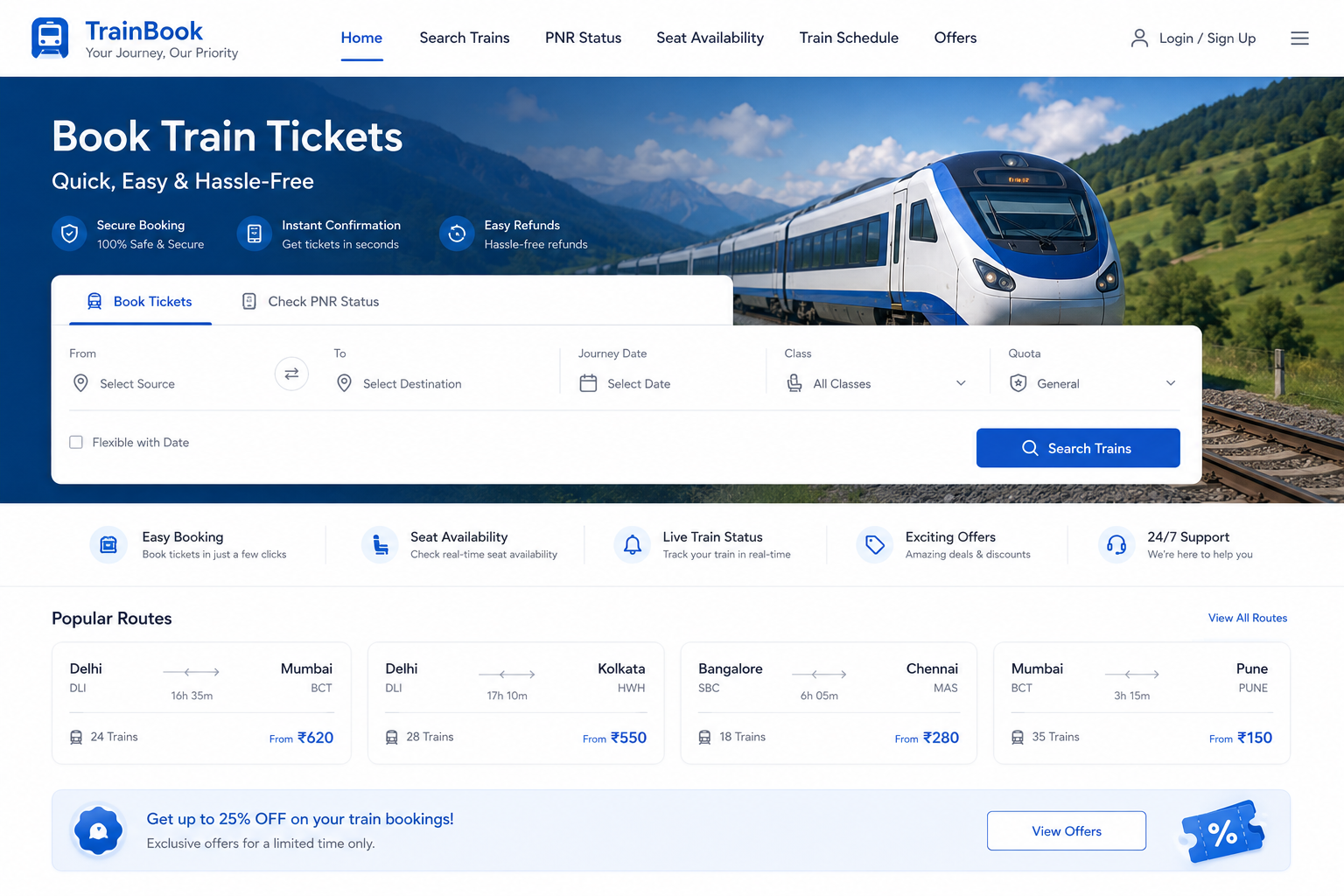
Why Build This?
Train ticket booking has constraints that most CRUD applications never face. Seats are finite, hundreds of users compete for the same inventory simultaneously, and unlike flight booking a single seat can be reused across segments of the journey.
I built this system to learn how real distributed patterns work under pressure: atomic locking, event choreography, CQRS, and idempotent processing. The goal wasn't just to make it work it was to understand why systems like IRCTC are architected the way they are.
The Architecture: Modular Monolith
I deliberately chose a modular monolith over microservices. The system is a single deployable Spring Boot JAR, internally split into independent modules: User, Train, Booking, Payment, and Notification. Each module owns its domain and communicates with others through Kafka events never through direct imports.
Why not microservices? Because for a learning project, microservices mean spending 80% of time on infrastructure (Kubernetes, service mesh, distributed tracing) and 20% on actual distributed patterns. A modular monolith flips that ratio. And the key insight: every module could be extracted into its own service later because the Kafka boundary already exists.
The discipline that makes this work: modules depend only on a shared railway-common library, never on each other. If the booking module needs train data, it receives it through a Kafka event not by importing TrainRepository.
The Hardest Problem: Segment-Based Seat Inventory
Unlike an airplane where a seat is either occupied or empty for the entire flight, a train seat is reusable across segments.
Consider a train running Delhi → Jaipur → Ahmedabad → Mumbai:
- Passenger A books Delhi → Jaipur (gets seat 15)
- At Jaipur, seat 15 is freed
- Passenger B can book Jaipur → Mumbai (gets the same seat 15)
So when checking if seat 15 is available for "Jaipur → Ahmedabad", you need to check if anyone occupies it on any overlapping segment. The seat_inventory table tracks availability per segment:
CREATE TABLE seat_inventory (
    id BIGSERIAL PRIMARY KEY,
    train_run_id BIGINT NOT NULL,
    coach_type VARCHAR(20) NOT NULL,
    from_station_id BIGINT NOT NULL,
    to_station_id BIGINT NOT NULL,
    total_seats INT NOT NULL,
    available_seats INT NOT NULL,
    version INT NOT NULL DEFAULT 0  -- Optimistic locking
);

CREATE INDEX idx_seat_inv_lookup
    ON seat_inventory(train_run_id, coach_type, from_station_id, to_station_id);
A booking from Delhi → Ahmedabad must decrement two segments (Delhi→Jaipur and Jaipur→Ahmedabad) but leave the Ahmedabad→Mumbai segment untouched. This is the fundamental data model that makes Indian railway booking work and it's what makes concurrency control so critical.
Distributed Seat Locking with Redis Lua Scripts
The core challenge: User A and User B both try to book the last seat at the same instant. Without coordination, both succeed and you've oversold a phantom seat.
Why not database locks? Row-level locks hold connections open for the entire payment window (up to 10 minutes). With 1000 concurrent bookings, you'd exhaust your connection pool.
The solution is a Redis Lua script that executes atomically:
-- Atomic seat lock script
local availKey = KEYS[1]
local lockKey = KEYS[2]
local requested = tonumber(ARGV[1])
local bookingId = ARGV[2]
local ttl = tonumber(ARGV[3])

local available = tonumber(redis.call('GET', availKey) or 0)

if available >= requested then
    redis.call('DECRBY', availKey, requested)
    redis.call('SET', lockKey, bookingId, 'EX', ttl)
    return 1  -- SUCCESS
end

return 0  -- FAILURE: not enough seats
Why Lua? Redis is single-threaded, but individual commands could interleave between your application's check-and-set operations. A Lua script runs as one atomic unit no other command can execute in the middle.
The Redis key structure makes lookups O(1):
seat-lock:{trainRunId}:{coachType}:{fromStn}:{toStn}:{bookingId} → "1" (TTL: 600s)
seat-avail:{trainRunId}:{coachType}:{fromStn}:{toStn}            → "42"
The system uses dual-layer safety: Redis lock (fast, might lose data on crash) + PostgreSQL @Version optimistic lock (durable, catches any slip-through). Belt and suspenders.
@Version
private Integer version;

// Repository: atomic decrement with version check
@Modifying
@Query("UPDATE SeatInventory s SET s.availableSeats = s.availableSeats - :count, "
     + "s.version = s.version + 1 "
     + "WHERE s.id = :id AND s.version = :expectedVersion")
int decrementSeats(@Param("id") Long id,
                   @Param("count") int count,
                   @Param("expectedVersion") int version);
If the version changed between read and write, the update affects 0 rows we know there was a conflict and can retry.
The Complete Booking Flow
When a user clicks "Book Now", here's what happens:
-
Idempotency Check Has this exact request been processed before? Redis for fast in-flight detection, plus a DB unique constraint as the durable backstop.
-
Validation At most 6 passengers, valid station pair, train run is in SCHEDULED status.
-
Check Availability Redis cache first (0.1ms), PostgreSQL fallback (2ms) if cache miss.
-
Lock Seats in Redis Lua script atomically decrements availability and sets a 10-minute TTL lock.
-
Decrement DB with Optimistic Lock PostgreSQL UPDATE with
@Versioncheck. If version conflict (someone else modified the row between our read and write), release the Redis lock and retry. -
Create Booking INSERT booking + passengers into PostgreSQL. Status:
PAYMENT_PENDING. Generate a unique PNR. -
Evict Cache Remove stale availability data from Redis. Next read re-populates from the DB.
-
Return PNR User has 10 minutes to complete payment before the lock auto-expires.
Event-Driven Architecture with Kafka
Instead of direct service-to-service calls, modules communicate through Kafka topics. The booking module publishes BOOKING_INITIATED it doesn't know or care who listens.
This architecture means:
- If the payment service is temporarily down, the booking still succeeds payment processes when the consumer catches up
- Adding a new notification channel (SMS, push) means adding a new consumer zero changes to existing code
- Each consumer is independently retryable with its own dead-letter topic
Every Kafka message is wrapped in an EventEnvelope carrying metadata:
public class EventEnvelope<T> {
    private String eventId;          // UUID  deduplicate events
    private String eventType;        // "BOOKING_CONFIRMED", "PAYMENT_SUCCESS"
    private String aggregateId;      // Entity this event is about (e.g., PNR)
    private String source;           // Which module published ("railway-booking")
    private String correlationId;    // Trace one user action across events
    private String idempotencyKey;   // Prevent double-processing on retries
    private Instant timestamp;
    private T payload;               // The actual event data
}
This standardized envelope means every consumer can handle routing, deduplication, and tracing without knowing the payload structure upfront.
The Payment Flow
Booking created (PAYMENT_PENDING)
  → User initiates payment
  → MockPaymentGateway processes (90% success, 50-200ms delay)
  → On success: publishes PAYMENT_SUCCESS to payment.events
    → PaymentEventConsumer confirms booking, evicts caches
    → NotificationConsumer sends confirmation
  → On failure: publishes PAYMENT_FAILED
    → Consumer restores seat inventory, releases Redis lock
    → User can retry
Cancellation & Waitlist Promotion (Choreography)
The most complex event flow: a single cancellation triggers a chain reaction across three modules without any central orchestrator.
Booking cancelled → seat inventory restored
  → BOOKING_CANCELLED published
    → Payment module initiates refund (95% success)
    → Booking module promotes next RAC → CONFIRMED
      → Then promotes next WAITLISTED → RAC
    → Notification module sends cancellation notice
Each consumer reacts independently. There's no saga coordinator to become a bottleneck. Adding "loyalty points refund" tomorrow means adding one new consumer existing code stays untouched.
CQRS with Elasticsearch
The read path for train search is completely separated from the write path. Writes go to PostgreSQL (source of truth). A Kafka-driven indexing pipeline builds denormalized documents in Elasticsearch for fast, full-text search.
Why separate stores? Displaying a search result in PostgreSQL requires JOINing trains + routes + route_stations + seat_inventory + coaches. In Elasticsearch, one document read returns everything no JOINs, sub-millisecond response.
The document model: one ES document per (trainRunId, fromStation, toStation) journey option. Each document is fully denormalized:
{
  "trainRunId": 42,
  "trainNumber": "12301",
  "trainName": "Rajdhani Express",
  "runDate": "2026-04-25",
  "fromStationCode": "NDLS",
  "fromStationName": "New Delhi",
  "toStationCode": "ADI",
  "toStationName": "Ahmedabad Junction",
  "departureTime": "16:25",
  "arrivalTime": "07:40",
  "durationMinutes": 915,
  "coachAvailabilities": [
    { "coachType": "FIRST_AC", "availableSeats": 42, "totalSeats": 72 },
    { "coachType": "SLEEPER", "availableSeats": 180, "totalSeats": 200 }
  ],
  "fares": [
    { "coachType": "FIRST_AC", "baseFare": 3450.00 },
    { "coachType": "SLEEPER", "baseFare": 750.00 }
  ]
}
A train with 5 stops creates C(5,2) = 10 documents every possible origin-destination pair.
Station search uses an edge ngram analyzer: typing "new d" instantly matches "New Delhi" through prefix tokenization. Coach type filtering uses ES nested queries to prevent cross-object false positives (without nested mapping, searching for "FIRST_AC with available > 0" could incorrectly match against SLEEPER's availability).
The tradeoff is eventual consistency there's a ~1-2 second lag between a booking changing seat counts in PostgreSQL and the search index reflecting the change. For train search, that's perfectly acceptable.
Caching Strategy
The system uses three distinct Redis caching patterns, each chosen for a specific access pattern:
Write-Through (Seat Availability) Every time availability changes, both PostgreSQL and Redis are updated. The cache is always current. Critical because stale availability data means selling seats that don't exist.
Cache-Aside (PNR Status) Only populated on reads. On status changes, the cache entry is evicted (not updated), and the next read rebuilds it from the DB. Simpler for complex nested data like multi-passenger PNR responses.
Sliding Window (Rate Limiting) Redis sorted sets track request timestamps per user per endpoint. A Lua script atomically removes expired entries, counts remaining, and either allows or rejects:
-- Sliding window rate limiter
local key = KEYS[1]
local window = tonumber(ARGV[1])
local limit = tonumber(ARGV[2])
local now = tonumber(ARGV[3])

redis.call('ZREMRANGEBYSCORE', key, 0, now - window)
local count = redis.call('ZCARD', key)

if count < limit then
    redis.call('ZADD', key, now, now .. math.random())
    redis.call('EXPIRE', key, window)
    return limit - count - 1  -- remaining quota
end

return -1  -- rate limited
Booking creation is limited to 5 requests/minute; availability search to 30/minute.
Scheduled Jobs
A ThreadPoolTaskScheduler (4 threads) runs background maintenance:
- Booking Cleanup (every 60s): Fails abandoned
PAYMENT_PENDINGbookings past their 10-minute timeout and restores seat inventory. - Train Run Generation (2 AM daily): Materializes abstract schedules into concrete, bookable train runs for the next 7 days.
- ES Reindex (3:30 AM daily): Full Elasticsearch reindex as a nightly safety net Kafka handles real-time, this catches any drift.
- Stale Data Cleanup (4 AM daily): Marks train runs older than 30 days as COMPLETED.
Key Takeaways
-
Pick the right consistency model for each operation. Seat locking needs strong consistency (Redis Lua + DB optimistic lock). Search results tolerate eventual consistency (CQRS with 1-2s lag). PNR lookups use stale-while-revalidate (cache-aside with TTL).
-
Dual-layer safety beats single-point-of-failure. Redis lock handles the fast path; PostgreSQL
@Versionis the durable backstop. If Redis crashes, the system is slower but still correct. -
Event choreography scales better than orchestration when modules need to remain independently deployable. No central coordinator means no single bottleneck and adding new reactions is purely additive.
-
A modular monolith gives you microservice patterns without microservice overhead. The Kafka boundaries enforce loose coupling at compile time. Extraction to separate services is an infrastructure decision, not an architectural one.
The full source code with Docker Compose setup (PostgreSQL, Redis, Kafka, Elasticsearch) is available on GitHub.